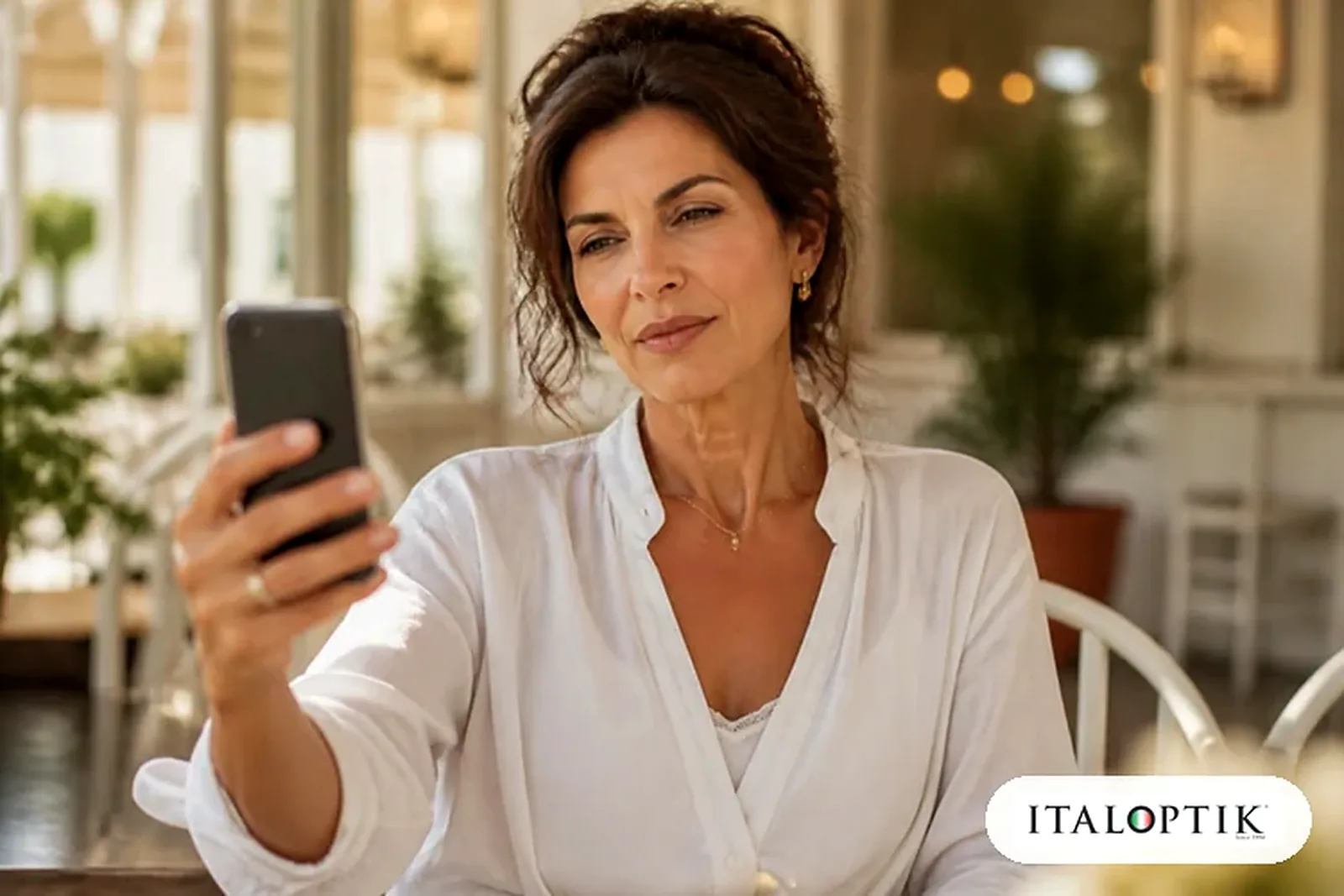
Have you ever held your phone further away to read a message? Or looked for brighter light to read a restaurant menu? You are not alone. After 40, almost everyone starts to notice this change. It has a name: presbyopia. And today there is a far more comfortable solution than carrying two pairs of glasses in your bag.
What is presbyopia?
Inside the eye there is a natural lens. When we are young it is soft and changes shape easily, so the eye can quickly switch focus from far to near. Over the years the lens hardens and loses its flexibility. The eye can no longer focus well up close, so small print looks blurry.
Presbyopia is not a disease. It is a natural part of life and it comes to everyone, even people who have always had perfect sight. It usually starts around 40–45 and increases little by little until around 60.
The most common signs
- You hold your phone, book or menu further away to read
- You need more light to read
- Your eyes get tired or you get headaches after reading or computer work
- Small print, like on medicine labels, looks blurry
- Your eyes take longer to switch from near to far
Two pairs of glasses? There is a simpler way
Many people over 50 carry two pairs of glasses: one for distance, for driving and TV, and one for near, for reading and the phone. All day they take them off and put them on, leave them in the car or at the office, and always need exactly the pair they don’t have with them.
Progressive glasses solve all of this with a single pair. The top of the lens is for distance, the middle for computer distance and the bottom for reading. The change from one zone to another is smooth, with no visible line, unlike old bifocals. From the outside they look like completely ordinary glasses.
That is why, for anyone who needs glasses for both distance and near, we recommend progressive glasses. With one pair you see clearly all day: when you drive, when you work at the computer and when you read.

AI-designed progressive glasses, for the first time in Albania
In December 2025, Italoptik was the first in Albania to bring progressive glasses designed with artificial intelligence.
What is different? Classic progressive lenses are built on standard models. With the new lenses, artificial intelligence has learned from a large amount of data how people’s eyes and heads move in everyday life, and it adapts the lens design to your personal measurements.
The other big difference is the way they are made. The lens surface is not produced with classic methods: it is carved by robots with very high precision, point by point, following the design calculated by artificial intelligence. Thanks to this, the vision channel, the clear zone in the middle of the lens that connects the distance area to the reading area, is much wider than in classic progressive lenses. With an expanded channel, the eyes move more freely and the wearer sees much more clearly, with less blur at the sides. The result:
- Clearer, wider vision at every distance
- Faster adaptation, many people get used to them in the first few days
- A more natural transition from far to near, with less head movement
- Less eye strain, even after many hours in front of a screen
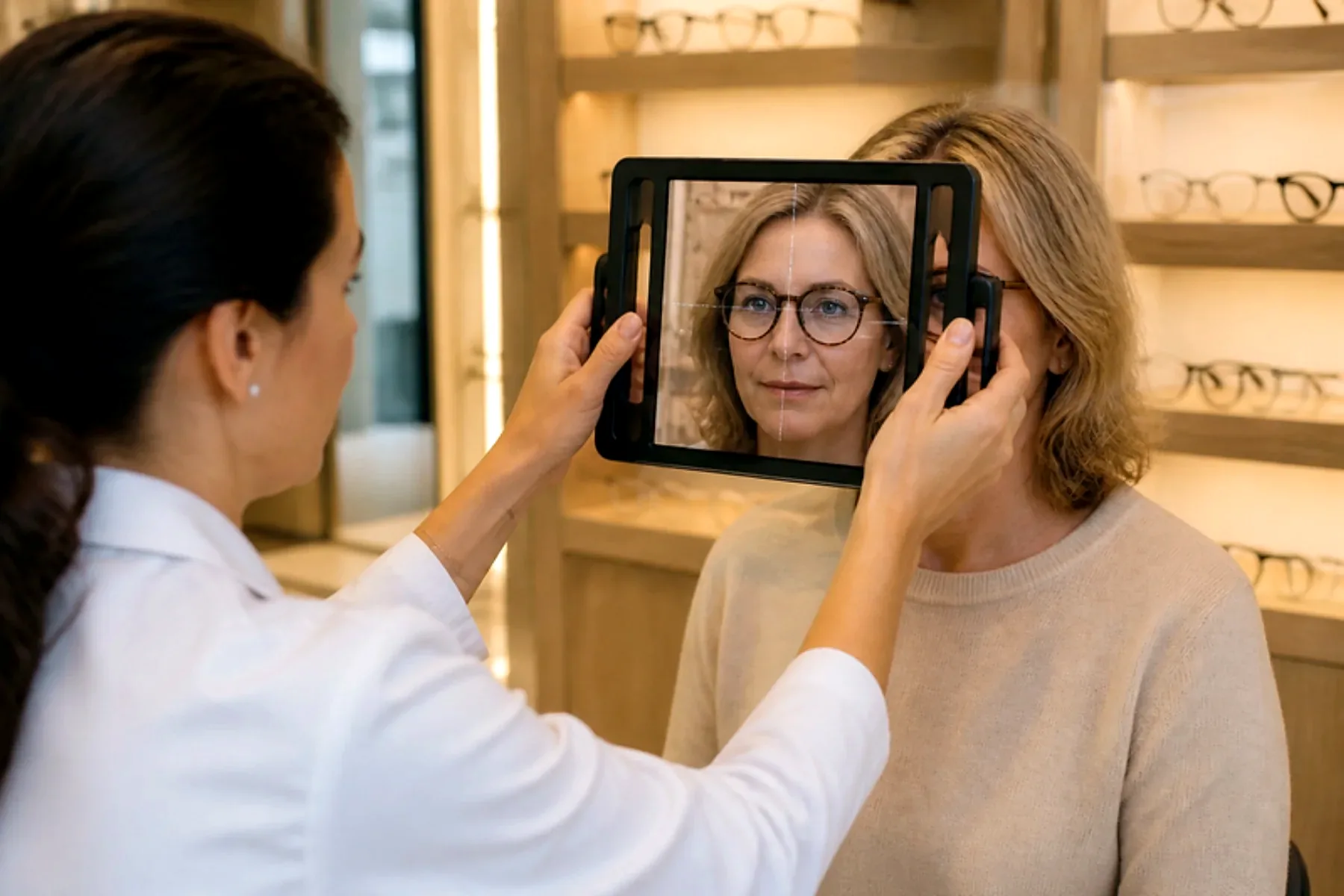
How we make your progressive glasses
- Eye exam. We check your eyes and measure the exact prescription for distance and near.
- Choosing the frame. We help you find glasses that look good on you and suit progressive lenses.
- Personal measurements. With modern equipment we measure the distance between your pupils, the height of your eyes in the frame and the way you wear your glasses.
- Production and fitting. When you collect them, we adjust them carefully to your face and explain how to use them in the first days.

How often should you have a check-up?
After 40 we recommend an eye check-up every 6 to 12 months, or whenever your doctor recommends it. Your prescription changes over time and your glasses should change with it.
Book your visit
Find us in Selvia, at the Castle (Kala) and in Fier. Our ophthalmologists and opticians will help you choose the progressive lenses that suit you best. Call us to book:
- Selvia: +355 4 222 2985 · +355 69 707 0097
- Kalaja: +355 69 203 9770
- Fier: +355 69 400 3377
This article is for information only and does not replace a visit to the ophthalmologist. The right solution is decided by the specialist after the exam.